Thursday, June 27, 2013

Ecuador more Democratic than USA


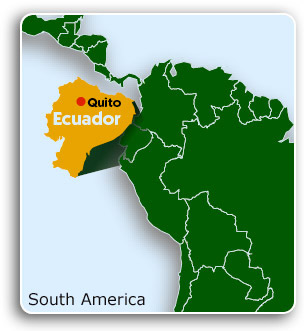
Ecuador's capital city has built a sustainable, eco-friendly city that puts most USA cities to shame:
Most taxis and many of the buses in Quito are operated by cooperatives, part of the booming solidarity sector made up of tens of thousands of community banks and credit unions and worker owned enterprises in the manufacturing, housing, agriculture and transport industries. It's important to note that this sector has grown along side, rather than instead of the traditional private and public sectors which have also seen healthy expansion.
People often ride the shared bikes provided by the city, use of which is available for a tiny yearly fee. Every Sunday a north south route through the city, including Avenue Amazonas, one of the city's main arteries, is given over entirely to cyclists and pedestrians, who come out in the thousands. The old airport, having been engulfed by urban expansion and replaced earlier this year, has also been turned over to the public as a park, and is already in use. 
Of course, everything is not perfect outside the city (violence, crime and poverty abound), but Ecuador is still moving in the right direction, expanding opportunities and safe, healthy, affordable living spaces for it's citizens rather than crying "austerity! cut everything!" like most "first world" democracies today:
Almost all this progress has occurred under the leadership of President Rafael Correa, a former economics professor who was made finance minister in 2005 during one of Ecuador's recurrent economic crises, running for the presidency the following year, assuming the office in 2007, and quickly bringing an era of unprecedented stability and prosperity. By the end of of 2012, unemployment had fallen to 4.1 percent, its lowest level on record and the poverty rate to 27.3 percent - that's 27 percent below what it was when Correa took power.
So, USA, care to take some notes?

Tuesday, June 25, 2013

Goodbye Right to Remain Silent

And today's episode of "Which USA Right is Dying Now?" is...

The right against self-incrimination! (5th Amendment to the US Constitution)

 In this case, Salinas v. Texas, Salinas remained silent when questioned and the judge used that as evidence of his guilt: "He had remained silent, and the Supreme Court had previously made clear that prosecutors can’t bring up a defendant’s refusal to answer the state’s questions. This time around, however, Justice Samuel Alito blithely responded that Salinas was “free to leave” and did not assert his right to remain silent." 

Why? Because Salinas didn't use the correct legal term when deciding to remain silent: "He was silent. But somehow, without a lawyer, and without being told his rights, he should have affirmatively “invoked” his right to not answer questions." 

 And that's not even the worst part..." Justice Clarence Thomas and Justice Antonin Scalia joined the judgment, but for a different reason; they think Salinas had no rights at all to invoke before his arrest (they also object to Miranda itself)."

I thought the courts were supposed to enforce the US Constitution...not destroy it?


Monday, May 27, 2013

CISPA Ends Internet Privacy in USA

Passed just last April: "CISPA is an extreme proposal that allows companies that hold our very sensitive information to share it with any company or government entity they choose, even directly with military agencies like the NSA, without first stripping out personally identifiable information," said Michelle Richardson, legislative counsel at the ACLU's Washington Legislative Office.

House Representative Alan Grayson (Florida), tried to introduce a tiny amendment to make sure a warrant was required before companies had to hand over info. But "The Rules Committee wouldn’t even allow debate on requiring a warrant before a search."

Why would the House rush through such a controversial bill?  Well, interest groups in support of the bill spent $605 MILLION DOLLARS lobbying Congress since 2011. That's 140 times as much as those who opposed the bill, who only spent $4.3m!  Why count since 2011?  Well that's when lobbying was allowed to get bigger than ever, because Citizens United vs. FCC had just taken off.  (The ironically named Citizens United* was a conservative group who sued the Federal Election Comission to allow corporations political "rights" to bribe--I mean, lobby--Congress unlimited amounts of money for the first time in US history.)

* ironic because it should have been named Corporations United.


Thursday, May 23, 2013

Healthcare Update

ACTUAL Liberal Propaganda: "Huge profits and the high administrative and marketing costs associated with a for-profit health insurance industry (31 cents out of every dollar!!!) make privatized health care in the U.S. the most expensive health care system in the world."

From OccuCards.com, a "non-profit" making educational materials to support the Occupy Movement.

And they even have a SOLUTION: "A solution to this problem is a universal health care system that eliminates the private insurance industry entirely (often referred to as a “single-payer” system). “By replacing the private insurers with a streamlined system of public financing,” writes PNHP, “our nation could save $400 billion annually in unnecessary, wasteful administrative costs. That’s enough to cover all the uninsured and to upgrade everyone else’s coverage without having to increase overall U.S. health spending.” Single-payer health care is supported by over 60% of the American people—including a majority of physicians—yet President Obama and the congressional leadership are silent on the issue, and the corporate media ignores or ridicules single-payer advocates."

Still not sure? "The United States is the only industrialized country in the world that does not provide universal health care for all of its citizens. Despite this, Americans pay on average twice as much for health care ($7,129 per capita annually) as do citizens of other industrialized nations, and tax-financed health spending is higher in the U.S. than any other country."

So, not only would it be cheaper on a personal level to get healthcare if we had single-payer, we'd also save on taxes.  What's to lose by switching?  Only tons and tons of paid lobbyists and for-profit business leaders would lose their income...and that's nothing to sneeze at.  Especially when you can't afford to get that sneeze checked out by a doctor!

Monday, May 13, 2013

Just Saying


Two of these are true, one is false. Check your guesses here.